

Last Updated on: 19th July 2026, 12:42 pm
TL;DR:
- Post-quantum SSL certificates use quantum-resistant algorithms to protect websites from future quantum computer attacks. Currently, full PQ certificates are not widely available, but hybrid certificates and partial protections through providers like Cloudflare are already in place. Small business owners should confirm TLS 1.3 usage, inquire about provider PQ plans, and stay patient until broad PQ support becomes standard between 2027 and 2030.
Post-quantum SSL certificates are specialized digital certificates designed to protect websites from future quantum computer attacks by using new cryptographic algorithms that quantum machines cannot break. If you run a small business website or freelance online, you have probably heard the term and wondered whether you need to act now. The short answer is: not immediately, but understanding what is coming will help you make smarter decisions about your hosting and security setup. Companies like Cloudflare and DigiCert are already building the infrastructure for this shift, and the transition will affect every website owner within the next few years. Understanding SSL certificate basics is the first step toward grasping why this upgrade matters.
Post-quantum SSL certificates explained: what non-tech users need to know first
To understand post-quantum SSL, you first need a clear picture of how regular SSL certificates work today. When you visit a website with a padlock icon in the browser bar, that padlock means an SSL certificate is active. The certificate does two things: it confirms the website is who it claims to be, and it encrypts the data traveling between your browser and the server so no one can intercept it.

Today’s SSL certificates rely on mathematical problems that are extremely hard for regular computers to solve. The two most common algorithms are RSA (Rivest-Shamir-Adleman) and ECC (Elliptic Curve Cryptography). Both work on the principle that factoring enormous numbers or solving certain geometric equations takes conventional computers thousands of years. That difficulty is the foundation of your website’s security right now.
Quantum computers change this equation completely. A sufficiently powerful quantum computer could solve the math behind RSA and ECC in hours or even minutes, using an algorithm called Shor’s algorithm. This is not science fiction. IBM, Google, and government research labs are actively building quantum hardware, and cryptographers treat the threat as a matter of when, not if.
The most alarming near-term risk is what security researchers call the “harvest now, decrypt later” attack. Here is what that means in practice:
- A bad actor intercepts and stores your encrypted website traffic today, even though they cannot read it yet.
- Years from now, when quantum computers are powerful enough, they decrypt that stored data.
- Any sensitive information transmitted over your site today, including customer data or login credentials, could be exposed in the future.
- This threat is already active. Nation-state actors are believed to be collecting encrypted data now.
- Standard SSL certificates offer zero protection against this specific attack vector.
Post-quantum cryptography (PQC) is the industry term for the new generation of algorithms designed to resist quantum attacks. Post-quantum SSL certificates use these PQC algorithms instead of RSA or ECC, making them resistant to both classical and quantum decryption attempts.
What makes post-quantum SSL different and how hybrid certificates work
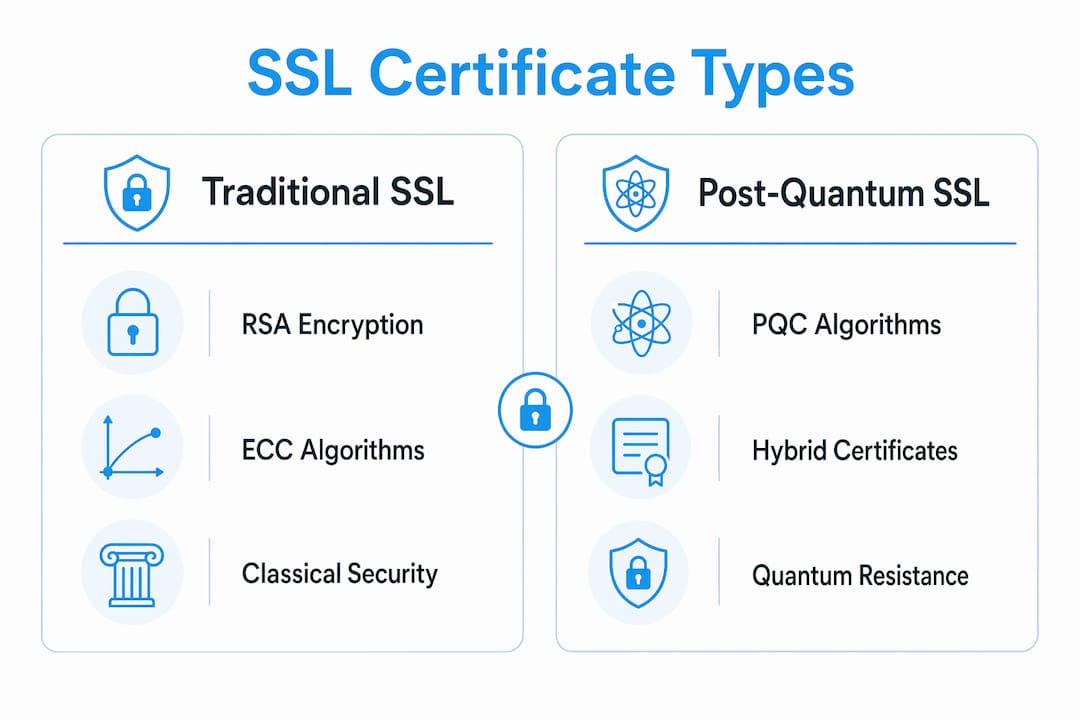
Post-quantum cryptography does not rely on the same mathematical problems as RSA or ECC. Instead, it uses problems based on lattice structures, hash functions, and other mathematical frameworks that even quantum computers struggle to crack. The U.S. National Institute of Standards and Technology (NIST) finalized its first set of PQC standards in 2024, with algorithms like ML-KEM (formerly CRYSTALS-Kyber) for key exchange and ML-DSA (formerly CRYSTALS-Dilithium) for digital signatures.
The practical challenge is that you cannot simply swap out one algorithm for another overnight. Browsers, servers, and certificate authorities all need to support the new standards simultaneously. This is why the industry developed hybrid certificates, which combine a classical algorithm like ECC with a post-quantum algorithm in the same certificate. Hybrid certificates use both classical and PQ cryptography to provide safety if one algorithm turns out to be broken, which is a smart hedge during any transition period.
Here is a side-by-side comparison to make the differences concrete:
| Feature | Traditional SSL (RSA/ECC) | Post-Quantum SSL (Hybrid/PQC) |
|---|---|---|
| Security against classical computers | Strong | Strong |
| Security against quantum computers | Vulnerable | Resistant |
| Browser compatibility | Universal | Limited (improving rapidly) |
| Performance impact | Minimal | Slightly larger handshake size |
| Availability | Widely available | Pilot programs only (as of 2026) |
| Cost | Standard pricing | Premium or experimental pricing |
| Future-proofing value | Low | High |
One detail that surprises most website owners: PQC for key exchange can be active before full PQ-certified server identity is deployed. This means your padlock icon in the browser will look exactly the same, but the underlying protection against quantum interception improves. The visual indicator does not change. The security does.
Pro Tip: If your website runs through Cloudflare, you may already have partial post-quantum protection active on your TLS connections without doing anything. Check your Cloudflare dashboard under SSL/TLS settings to see which TLS version and cipher suites are active.
The performance impact of hybrid certificates is real but modest for most websites. Hybrid PQ TLS generates larger handshake payloads due to PQ signature sizes, which can affect older or resource-constrained devices. For a typical small business website, this difference is negligible on modern hardware and broadband connections.
What is the current state of post-quantum SSL adoption?
The honest answer is that post-quantum SSL certificates are not yet available for general purchase from public certificate authorities. No publicly trusted PQ SSL certificates are generally available as of mid-2026. Pilot programs are expected between 2027 and 2028, with general availability projected for 2029 to 2030. This timeline is important because it means you are not behind if you have not acted yet.
What is already active is post-quantum hybrid key exchange at the transport layer. Cloudflare supports PQ hybrid key agreement on most TLS 1.3 traffic, though full quantum resistance depends on whether the visitor’s browser also supports the PQ key exchange method. Cloudflare targets full post-quantum security by 2029, which aligns with the broader industry timeline. However, market leaders in this field, such as Sectigo and DigiCert, are already building the foundation, and you can expect hybrid post-quantum SSL certificates to become commercially available for purchase from them within the next few years.
Here is what this means for you as a website owner right now:
- Your hosting provider or CDN may already be handling PQ hybrid TLS key agreements transparently. Many hosting providers integrate PQ hybrid TLS at the service level, so you may already have some protection without any manual setup.
- TLS 1.3, the current standard protocol, was specifically designed to support new key exchange methods like PQC without major changes to how connections are established. If your site uses TLS 1.3, you are in a good position for the transition.
- Full post-quantum security, including quantum-safe authentication of your server’s identity, requires quantum-safe hardware security modules (HSMs) for certificate signing. This is a backend infrastructure challenge that certificate authorities like DigiCert are actively working to solve.
- The biggest operational hurdles are not on your end. They are in the certificate authority infrastructure and browser trust stores, both of which are being updated by organizations like Google, Mozilla, and Apple.
The gap between “PQ key exchange is active” and “PQ certificates are issued” is not a failure. It is a deliberate, phased approach to avoid breaking the internet while upgrading it.
Practical steps you can take today as a small business owner
You do not need to overhaul your website security right now. What you do need is a clear plan so you are not caught off guard when the transition accelerates. Here are the steps that actually matter:
Confirm your site uses TLS 1.3. Log into your hosting control panel or ask your provider. TLS 1.3 is the protocol version that supports PQ key exchange. If you are still on TLS 1.2, ask your host to upgrade you. Most reputable providers have already done this automatically.
Ask your certificate authority or hosting provider about their PQ roadmap. DigiCert, Let’s Encrypt, and Sectigo all have public statements about their post-quantum plans. A simple support ticket asking “Do you support post-quantum cryptography and when will PQ certificates be available?” will tell you whether your provider is prepared.
Keep your platform and TLS libraries updated. If you use WordPress, Shopify, or any managed platform, keep it current. Platforms push TLS library updates that include PQ support as it becomes available. Outdated software is the most common reason websites miss security upgrades.
Do not buy a “PQ certificate” from an unverified vendor right now. No publicly trusted PQ SSL certificates exist yet. Any vendor claiming to sell a fully quantum-safe certificate for your website today is either selling something experimental or misleading you. Wait for certificates issued through established certificate authorities.
If you use Cloudflare or a similar CDN, you are already partially covered. Cloudflare’s PQ hybrid key exchange is active on TLS 1.3 connections. You do not need to do anything extra to benefit from this layer of protection.
Pro Tip: Use SSL Labs’ free SSL Server Test at ssllabs.com/ssltest to check your site’s current TLS version and cipher suite support. It takes two minutes and gives you a clear picture of where you stand before the PQ transition accelerates.
For guidance on cloud security best practices as the PQ landscape evolves, reviewing what enterprise-level providers are doing gives you a useful benchmark for what to expect from your own hosting environment.
Traditional SSL vs. post-quantum SSL: a plain-language comparison
Understanding the difference between what you have now and what is coming helps you set realistic expectations. This is not about one being broken and the other being perfect. It is about preparing for a specific future threat.
| Aspect | Traditional SSL | Post-Quantum SSL |
|---|---|---|
| Protects against today’s hackers | Yes | Yes |
| Protects against quantum computers | No | Yes |
| Works in all browsers | Yes | Not yet universally |
| Available to buy now | Yes | No (pilot phase) |
| Affects site speed noticeably | No | Minimal impact expected |
| Needed urgently | Already required | Plan for 2027 to 2030 |
The key takeaway from this comparison is that traditional SSL is not failing you today. The urgency around post-quantum security is about protecting data that is being collected now against attacks that will happen later. For most small business websites, the practical window to act is 2027 to 2029, when PQ certificates become commercially available and browser support reaches critical mass.
My take: don’t panic, but don’t ignore this either
Over the years, I have seen plenty of security trends in the website industry that created more anxiety than they ultimately warranted. In my view, post-quantum SSL certificates are generating a similar mix of excitement and uncertainty today. The reality, however, is more measured.
The threat posed by quantum computers is real, but it is not a reason to panic in 2026. Instead, it is something website owners should start considering as a planning priority for the 2028–2030 timeframe.
What I find genuinely reassuring is that the infrastructure layer is already moving. Cloudflare handling PQ hybrid TLS at the CDN level means millions of websites already have partial protection without their owners knowing or doing anything. That is how good security transitions should work. The complexity stays with the experts, and the benefit flows to everyone.
Where I would push back on the “just wait” attitude is with hosting provider selection. If you are evaluating a new host or CDN today, their post-quantum roadmap should be part of your checklist. A provider with no public statement on PQC in 2026 is a provider that may leave you scrambling in 2028. Ask the question. The answer tells you a lot about how seriously they take long-term security.
The one thing I would not do is spend money on anything marketed as a “post-quantum certificate” right now. The standards are finalized, but the certificate authority infrastructure is not ready. Patience here is not complacency. It is the right call.
— Stefan
How Digi Host Guide helps you stay ahead of your website’s security
Choosing a hosting provider that keeps pace with security developments like post-quantum cryptography is one of the most practical decisions you can make for your website’s long-term safety. Digi Host Guide’s hosting provider reviews evaluate providers on performance, reliability, and security practices, giving you a clear picture of which hosts are building for the future. If you are just getting started and want to understand how hosting connects to security fundamentals, the top hosting providers comparison is a solid place to begin. Staying informed now means you will not be caught off guard when PQ certificates become the new standard between 2027 and 2030.
FAQ
What is a post-quantum SSL certificate?
A post-quantum SSL certificate is a digital certificate that uses quantum-resistant cryptographic algorithms, such as ML-KEM or ML-DSA, to protect websites against attacks from quantum computers. Unlike traditional SSL certificates based on RSA or ECC, these certificates remain secure even if a quantum computer attempts to break the encryption.
Can I buy a post-quantum SSL certificate today?
No publicly trusted post-quantum SSL certificates are available for general purchase as of mid-2026. Pilot programs are expected from 2027 to 2028, with broad availability projected for 2029 to 2030 through certificate authorities like DigiCert and Let’s Encrypt.
Does my website already have any post-quantum protection?
If your site runs through Cloudflare or a CDN that supports TLS 1.3 with PQ hybrid key exchange, you likely already have partial post-quantum protection at the transport layer, even without a PQ certificate. This protects against “harvest now, decrypt later” attacks on your traffic.
Do I need to do anything right now to prepare?
The most useful steps today are confirming your site uses TLS 1.3, keeping your platform updated, and asking your hosting provider about their PQ roadmap. There is no need to replace your current SSL certificate yet.
Will post-quantum SSL slow down my website?
Hybrid PQ TLS generates slightly larger connection handshakes due to bigger key sizes, but the performance impact on modern hardware and standard broadband connections is minimal. Most small business websites will not notice a measurable difference in load times.

