

Last Updated on: 23rd May 2026, 10:45 am
A surprising number of small business owners and developers assume that shared hosting will continue to meet their needs as their sites grow. That assumption is one of the most common and costly mistakes in web hosting. When traffic spikes, shared servers buckle, page load times climb, and customers leave. Dedicated hosting works differently. It gives you an entire physical server, exclusively yours, so performance stays consistent regardless of what other websites are doing. This guide explains exactly how dedicated hosting works, who it’s built for, and how it compares to the alternatives.
Table of Contents
- What is dedicated hosting?
- Dedicated vs. shared vs. cloud hosting: A practical comparison
- Key benefits of dedicated hosting for businesses
- Is dedicated hosting right for you? Use cases and considerations
- Why dedicated hosting is often overlooked — and why it matters
- Explore trusted hosting solutions with Digi Host Guide
- Frequently asked questions
Key Takeaways
| Point | Details |
|---|---|
| Total server control | Dedicated hosting lets you customize every software and security setting for your site. |
| Performance reliability | Your website keeps running at its best even during traffic spikes with dedicated resources. |
| Enhanced security | Exclusive access greatly reduces risk from other users and gives stronger protection for business data. |
| Ideal for growing businesses | Dedicated hosting is best for scaling sites and applications that need power and flexibility. |
What is dedicated hosting?
Dedicated hosting means renting a complete physical server from a hosting provider. That server is assigned to you and only you. No other website or application shares its CPU, RAM, storage, or bandwidth. Think of it like the difference between renting your own house versus living in an apartment building where everyone shares the same plumbing.
Here’s what that translates to in practical terms:
- Exclusive resources: Every bit of processing power and memory is available to your site alone.
- Custom configurations: You can install the operating system, software, and security tools that match your exact needs.
- Full root access: You have administrator-level control over the server environment, which is important for developers building custom applications.
- Predictable performance: Because no other tenants are sharing your resources, your site’s speed stays stable even during traffic surges.
- Higher cost, higher value: Dedicated servers cost more than shared or VPS (Virtual Private Server) hosting, but the return in reliability and control is significant for the right use case.
VPS hosting sits somewhere in the middle. A physical server is divided into virtual segments, each with allocated resources. It’s more isolated than shared hosting but still not fully exclusive. Dedicated hosting removes that limitation entirely.
Pro Tip: If your site regularly receives thousands of visitors per day or handles sensitive customer data, dedicated hosting is worth serious consideration. The performance and security gains often outweigh the higher monthly cost.
Dedicated vs. shared vs. cloud hosting: A practical comparison
With a clear definition in place, it’s time to see how dedicated hosting stacks up against other popular options. Understanding the web hosting service types available will help you identify the right fit for your business.
| Feature | Shared hosting | Cloud hosting | Dedicated hosting |
|---|---|---|---|
| Resource access | Shared with others | Distributed across nodes | Fully exclusive |
| Performance | Variable, can slow down | Scalable but variable | Consistently high |
| Security | Lower isolation | Moderate | Highest isolation |
| Customization | Limited | Moderate | Full control |
| Cost | Lowest | Mid-range | Highest |
| Best for | Small blogs, startups | Growing businesses | High-traffic or business-critical sites |
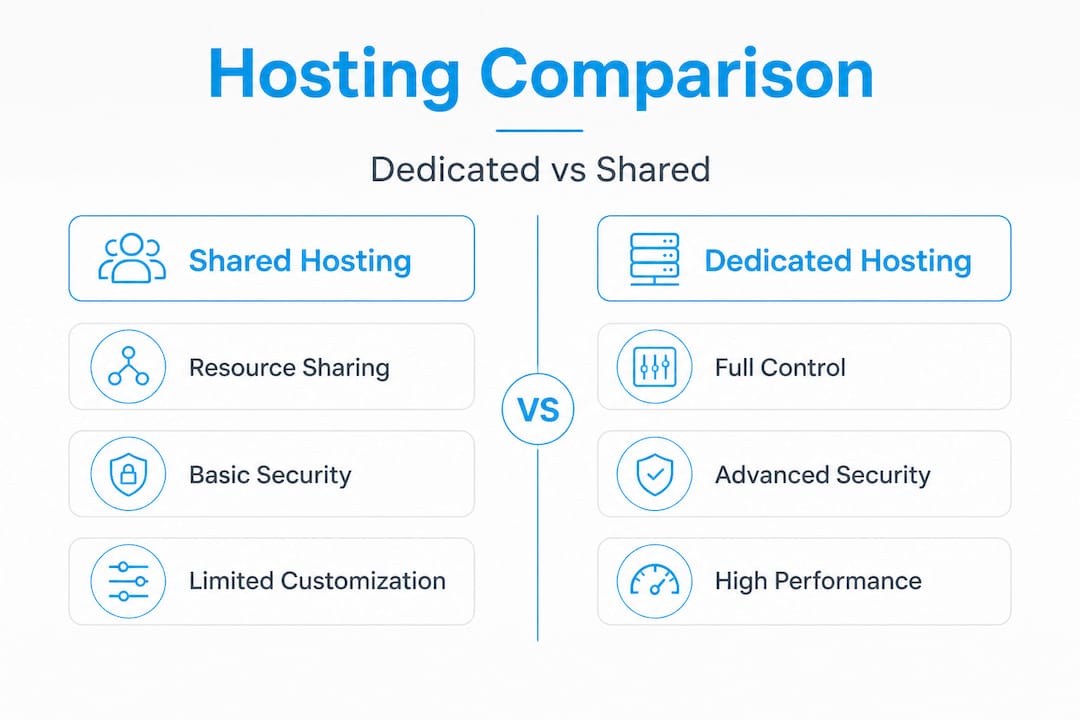
Shared hosting explained shows that shared plans are a good starting point for low-traffic websites and personal projects. The problem is that resources are pooled. When one site on the server spikes in traffic, others slow down. That’s the “noisy neighbor” effect, and it’s a real performance risk.
Cloud hosting, covered in detail in cloud hosting basics, offers flexibility through distributed infrastructure. Your site’s resources can scale up or down as needed. However, cloud server management comes with its own complexity, and control over the physical environment remains limited. For businesses that need full software freedom or strict data isolation, cloud hosting still falls short.
The key advantages of dedicated hosting in this comparison are:
- No resource contention: You never compete with other tenants for bandwidth or processing power.
- Better security posture: Your data is isolated on a single server with no risk of cross-contamination from other accounts.
- Compliance-friendly: Industries like healthcare, finance, and legal services often require isolated server environments to meet regulatory standards.
Studies consistently show that a one-second delay in page load time can reduce conversions by up to 7%. On a shared server, that delay can happen without warning. Dedicated hosting removes that variable entirely.

If you’re exploring general hosting services for the first time, it’s worth mapping out your current traffic levels, growth projections, and security requirements before committing to any plan.
Key benefits of dedicated hosting for businesses
Seeing the comparisons, let’s dig deeper into the core benefits that make dedicated hosting the smart choice for business owners.
Enhanced performance. Your site has access to 100% of the server’s CPU and RAM at all times. Pages load faster, databases respond quicker, and applications run without interruption. For ecommerce sites, this directly impacts revenue and customer trust.
Stronger security. With no other accounts on your server, you control every security layer. You can configure firewalls, install custom security software, and monitor activity without interference. Businesses handling payment data or personal customer records especially benefit here. Following web security tips becomes much more effective when you have full control over the environment.
Complete customization. Need a specific PHP version, a custom database configuration, or a proprietary application stack? Dedicated servers let you build exactly that. Shared hosting often restricts software versions and configurations to suit the broadest user base. That’s not a limitation you’ll face here.
Reliable uptime. Server uptime, meaning the percentage of time your site is accessible online, is critical for customer-facing applications. Reputable dedicated hosting providers typically guarantee 99.9% uptime or better, backed by service level agreements.
“Choosing the right hosting plan is one of the most important infrastructure decisions a business makes. Getting it wrong means rebuilding under pressure.”
Pro Tip: When reviewing providers, always check what’s included in their managed dedicated hosting plans. Managed plans handle server maintenance, updates, and monitoring for you, which is ideal if you don’t have a full-time IT team. You can explore choosing web hosting to understand what questions to ask before signing up.
For a broader look at providers, hosting review summaries and top web hosts can help you compare real-world performance data and pricing structures before making a decision.
Is dedicated hosting right for you? Use cases and considerations
To wrap up the guide, let’s look at real-world scenarios and practical tips to determine if dedicated hosting aligns with your business goals.
| Business scenario | Dedicated hosting: Good fit? |
|---|---|
| Online store with 10,000+ monthly visitors | Yes |
| Small personal blog with low traffic | No, shared is fine |
| Business app handling sensitive customer data | Yes |
| Startup testing a new product | Likely no, start with cloud |
| Regulated industry (healthcare, finance) | Yes |
| Developer needing custom server environment | Yes |
The scenarios above highlight a clear pattern. Dedicated hosting delivers real value when your business depends on consistent performance, strict security, or technical flexibility. For sites just getting started, the cost is hard to justify.
Here are the factors worth weighing before you decide:
- Traffic volume: Sites seeing consistent high traffic need dedicated resources to maintain load times.
- Data sensitivity: If you store customer payment info, health records, or confidential business data, isolation matters.
- Compliance requirements: Some industries legally require isolated server environments.
- Technical capacity: Unmanaged dedicated servers require hands-on administration. If your team doesn’t have that skill set, choose a managed plan.
- Budget: Dedicated hosting starts at a higher monthly cost than shared or VPS options. Make sure the ROI (return on investment) is clear.
For businesses managing email alongside their hosting, reviewing email hosting tips can help you integrate communication tools without adding security risk. You should also familiarize yourself with essential security features to ensure your server setup is protected from day one. When you’re ready to make the call, the web host selection guide walks you through the full decision process step by step.
Why dedicated hosting is often overlooked — and why it matters
Here’s the honest truth most hosting guides won’t tell you: the web hosting industry has a strong financial incentive to push shared and cloud plans. They’re easier to sell, easier to scale, and far more profitable per server. Dedicated hosting requires more infrastructure investment and more customer support. So it gets less marketing attention, fewer discount promotions, and less visibility in comparison tools.
The result? Many businesses running high-traffic sites or customer-critical applications are sitting on shared or cloud infrastructure that’s actively limiting their growth. They assume the occasional slowdown is normal. It isn’t.
What we’ve seen repeatedly is that businesses making the switch to dedicated hosting notice the difference almost immediately. Pages load faster. Support tickets about downtime drop. Customer checkout flows stop timing out. The performance improvement isn’t gradual. It’s immediate and measurable.
There’s also a mindset shift worth noting. Businesses that invest in dedicated hosting tend to treat their web infrastructure more seriously overall. They monitor performance more closely, apply security patches faster, and build more resilient applications. The choice of hosting reflects a broader operational maturity.
If you’re mapping out your infrastructure options, start by reviewing the full range of web hosting service types so you understand the full landscape before committing.
Explore trusted hosting solutions with Digi Host Guide
If you’re ready to take the next step or want a closer look at top providers, here’s how Digi Host Guide can help. We publish detailed, experience-based hosting reviews covering performance benchmarks, pricing structures, and support quality so you can make a confident decision. Not sure which plan category fits your needs yet? Our breakdown of types of hosting services gives you a clear overview of every major option, from shared to dedicated to managed cloud. Whether you’re upgrading from a shared plan or building your first high-traffic site from scratch, DigiHost Guide gives you the structured reviews and insights you need to move forward with clarity.
Frequently asked questions
How is dedicated hosting different from VPS hosting?
Dedicated hosting gives you exclusive access to a physical server, while VPS hosting splits a single physical server into multiple virtual segments that are shared among users.
Is dedicated hosting more secure than shared hosting?
Yes. Dedicated hosting offers enhanced security through full resource isolation, removing the risk of cross-contamination from other accounts on the same server.
Do I need technical expertise to manage dedicated hosting?
Some technical knowledge is helpful, but many providers offer fully managed plans that handle server maintenance, updates, and monitoring on your behalf.
What types of businesses benefit most from dedicated hosting?
High-traffic ecommerce sites, regulated industries requiring data isolation, and developers building custom applications stand to gain the most from dedicated hosting.
Can I upgrade to dedicated hosting from shared or VPS hosting easily?
Most providers support upgrades, though migration often requires planning and technical support to transfer data and minimize downtime during the transition.
